Influence of driver on energy consumption: driver behaviour has a major impact on the energy demand estimation. The main influential factors are purposes and situations (as e.g. work trips with time constraints and leisure trips without time constraints), as well as the application of auxiliary consumers.
Development of hybrid data fusion algorithms integrating state of energy of the vehicle and geographical data are required for a secure trip in electric vehicle and to reduce the anxiety caused by a limited driving range and large charging times of electric vehicles.
Advanced multi-modal transport models include macroscopic, mesoscopic, microscopic and agent-based transport simulation models for assessing the multi-modal transport. Furthermore integration of electric mobility that extends existing transportation modes with electric mobility services, first and foremost public transport modes and carsharing solutions to enable users to meet their mobility needs with an optimal combination of transport modes including electric mobility. In addition electrification of commercial fleets for 1) electrification of fleets for logistics and other services providers and 2) paradigm change for company car fleets towards multi-modal, shared and electric mobility are highlighted. The development of a new concept of lightweight L-category electric vehicle electric mobility and linked business model, as well as micro solutions, is discussed as well as recommendation for development of regulation and standards enabling the use of the electric vehicle fleets.
Tourism is the economic activity of the islands. The integration of the fleet of an electric vehicle could play an important role to facilitate the access of touristic area by foreigners and to develop a component of electric storage of renewable energy based on vehicle to grid concept. In the framework of islands, this deployment is also justified by the fact that large tourism activity is present on the island and that green tourism would benefit from this approach. On an island or Mediterranean coast area, terrestrial mobility is concerned as well as the local maritime vehicle.
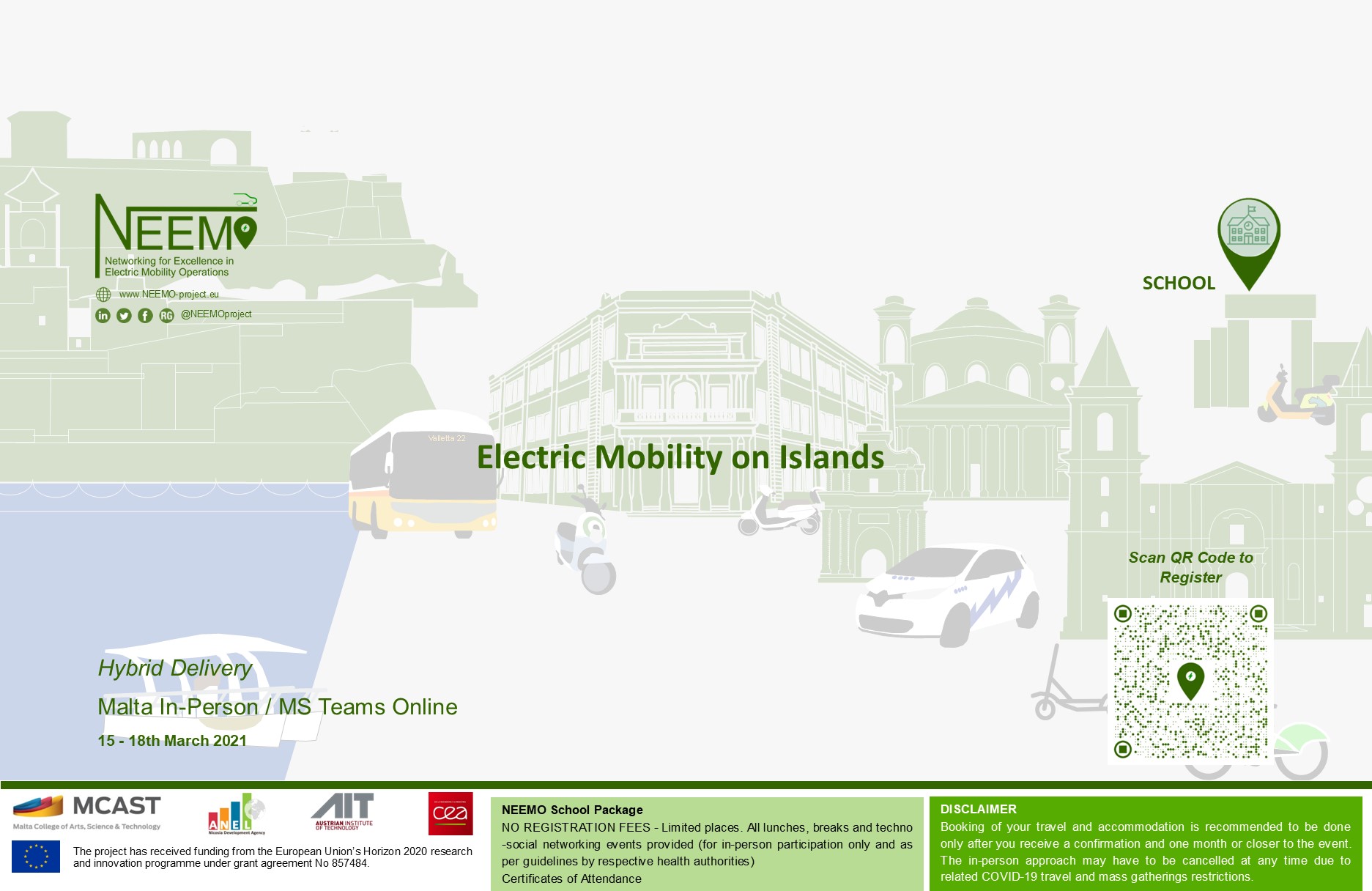
Energy dependence on fossil fuel has a strong negative impact on the economy and the environment for a state. This is more particularly the case of island states like Malta or Cyprus. This School is the first in a series of three Schools addressing electric mobility on islands with the opportunity to master excellently the main concepts relating to the identified topic. This school also explores state-of-the-art theories and frameworks. The participants will be exposed to apply these methods and evaluate solutions to problems by adopting scholarly approaches.