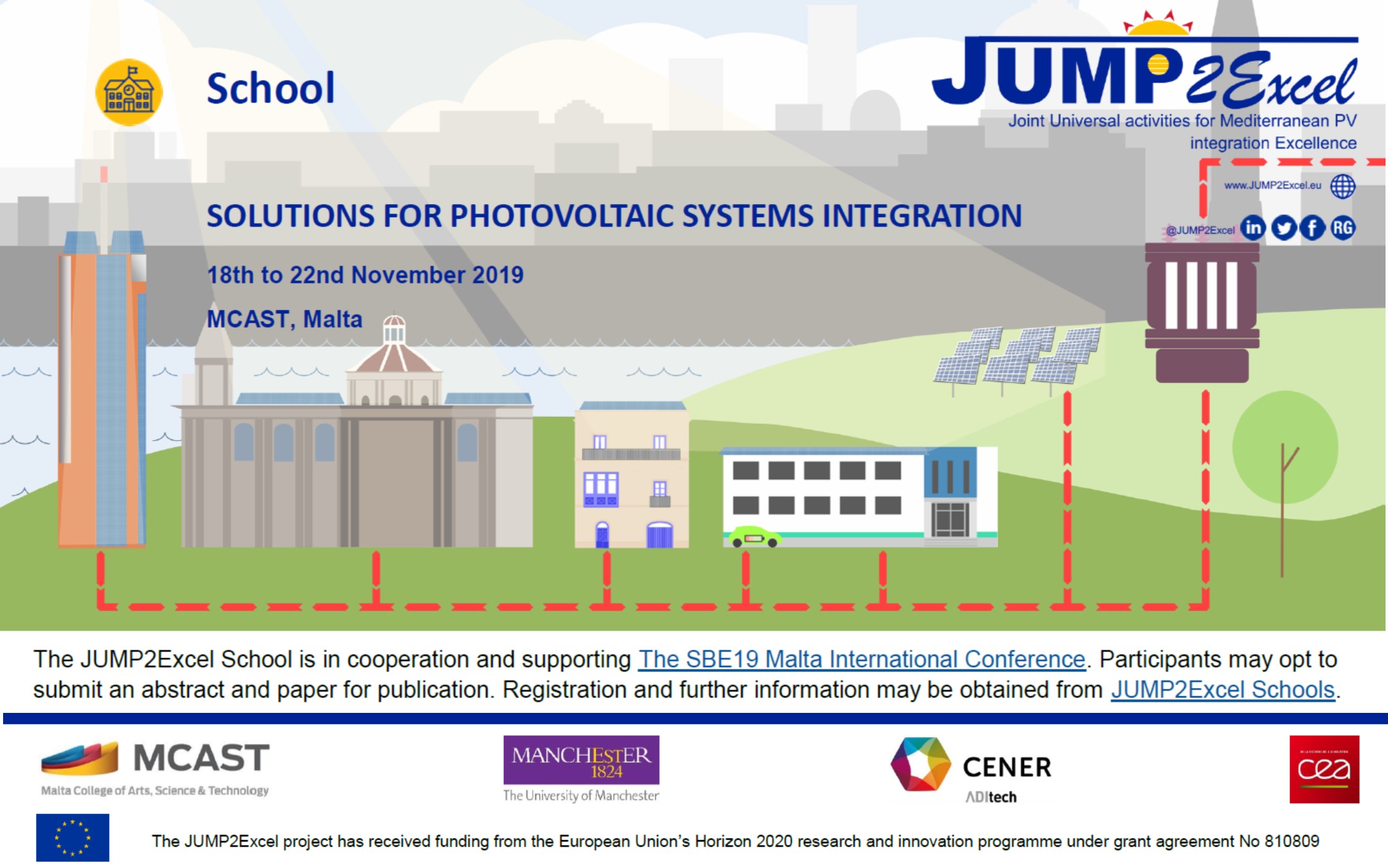
The Malta College of Arts, Science and Technology (MCAST) Energy Research Group (MCASTEnergy) in partnership with The University of Manchester, CENER (Spain) and CEA (France) are inviting you to the 3rd JUMP2Excel Training School.
The school is directed to early-career professionals and early career researchers including students aspiring for a research career in academia, research centres or industry. The JUMP2Excel Training School offers a fast-paced comprehensive overview, followed by advanced lectures.
The link for registration for the school is available here: https://tinyurl.com/5cp3y886
The School has the MCAST Energy Day Conference integrated on the 28th February 2022, with keynote speakers and outputs of JUMP2Excel projects highlights.
Influence of driver on energy consumption: driver behaviour has a major impact on the energy demand estimation. The main influential factors are purposes and situations (as e.g. work trips with time constraints and leisure trips without time constraints), as well as the application of auxiliary consumers.
Development of hybrid data fusion algorithms integrating state of energy of the vehicle and geographical data are required for a secure trip in electric vehicle and to reduce the anxiety caused by a limited driving range and large charging times of electric vehicles.
Advanced multi-modal transport models include macroscopic, mesoscopic, microscopic and agent-based transport simulation models for assessing the multi-modal transport. Furthermore integration of electric mobility that extends existing transportation modes with electric mobility services, first and foremost public transport modes and carsharing solutions to enable users to meet their mobility needs with an optimal combination of transport modes including electric mobility. In addition electrification of commercial fleets for 1) electrification of fleets for logistics and other services providers and 2) paradigm change for company car fleets towards multi-modal, shared and electric mobility are highlighted. The development of a new concept of lightweight L-category electric vehicle electric mobility and linked business model, as well as micro solutions, is discussed as well as recommendation for development of regulation and standards enabling the use of the electric vehicle fleets.
Tourism is the economic activity of the islands. The integration of the fleet of an electric vehicle could play an important role to facilitate the access of touristic area by foreigners and to develop a component of electric storage of renewable energy based on vehicle to grid concept. In the framework of islands, this deployment is also justified by the fact that large tourism activity is present on the island and that green tourism would benefit from this approach. On an island or Mediterranean coast area, terrestrial mobility is concerned as well as the local maritime vehicle.
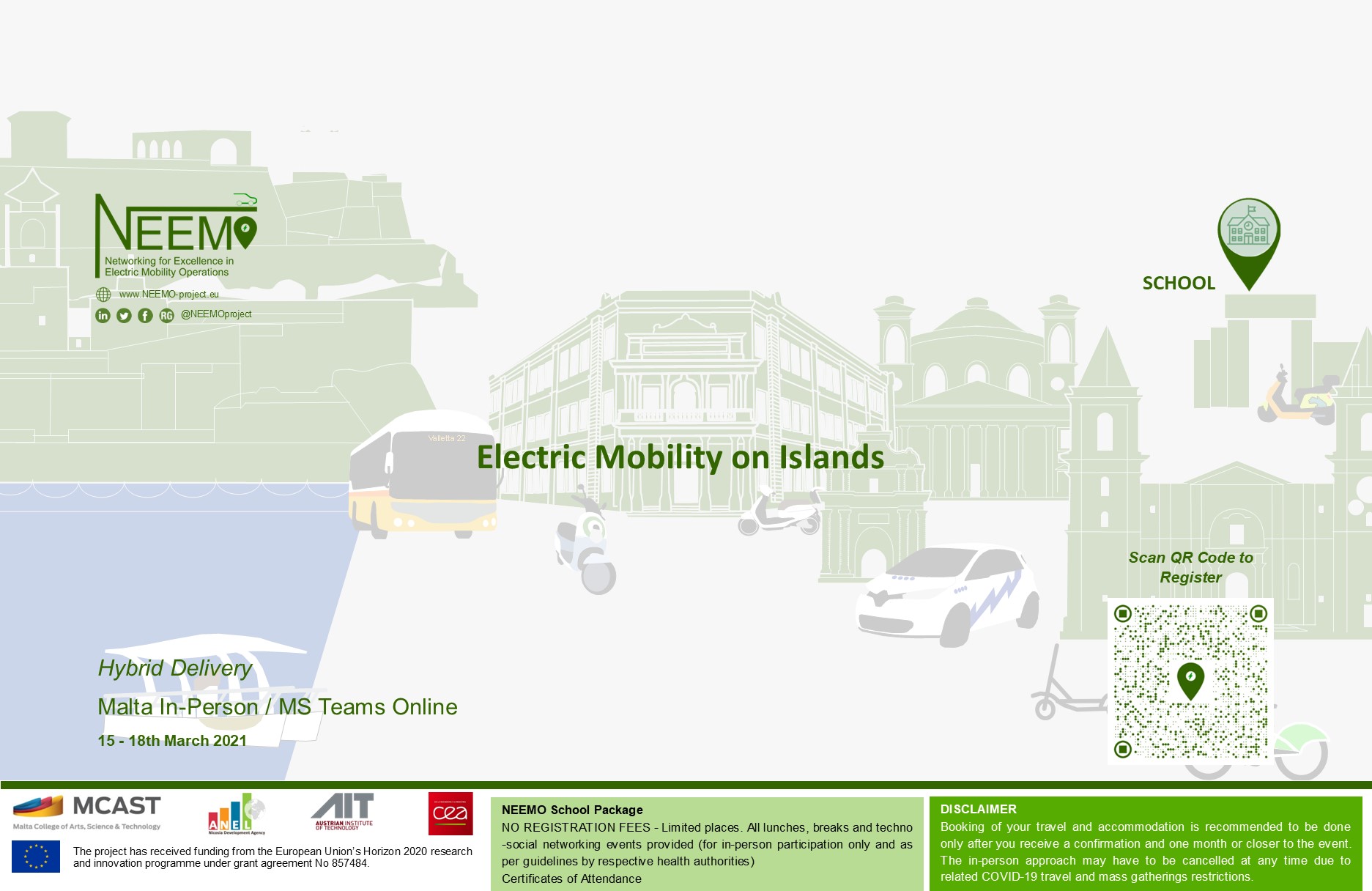
Energy dependence on fossil fuel has a strong negative impact on the economy and the environment for a state. This is more particularly the case of island states like Malta or Cyprus. This School is the first in a series of three Schools addressing electric mobility on islands with the opportunity to master excellently the main concepts relating to the identified topic. This school also explores state-of-the-art theories and frameworks. The participants will be exposed to apply these methods and evaluate solutions to problems by adopting scholarly approaches.
Research, development, adaption and testing of emerging Photovoltaic (PV) devices especially third generation of solar PVs such as organic, perovskites or a hybrid version is a principal area of concentration of the JUMP2Excel programme. In this last 4 years PV technology has experienced an amazing efficiency evolution and the records efficiency has been surpassed. The main advantages of these PV technologies are driven by potential low-cost synthesis, higher absorption coefficient, long carrier diffusion length, low exciton binding energies and long-range ambipolar transport characteristics. However, there are still major challenges to solve for PV technology including device stability, hysteresis, and difficulties in fabrication of large area and/or flexible devices.
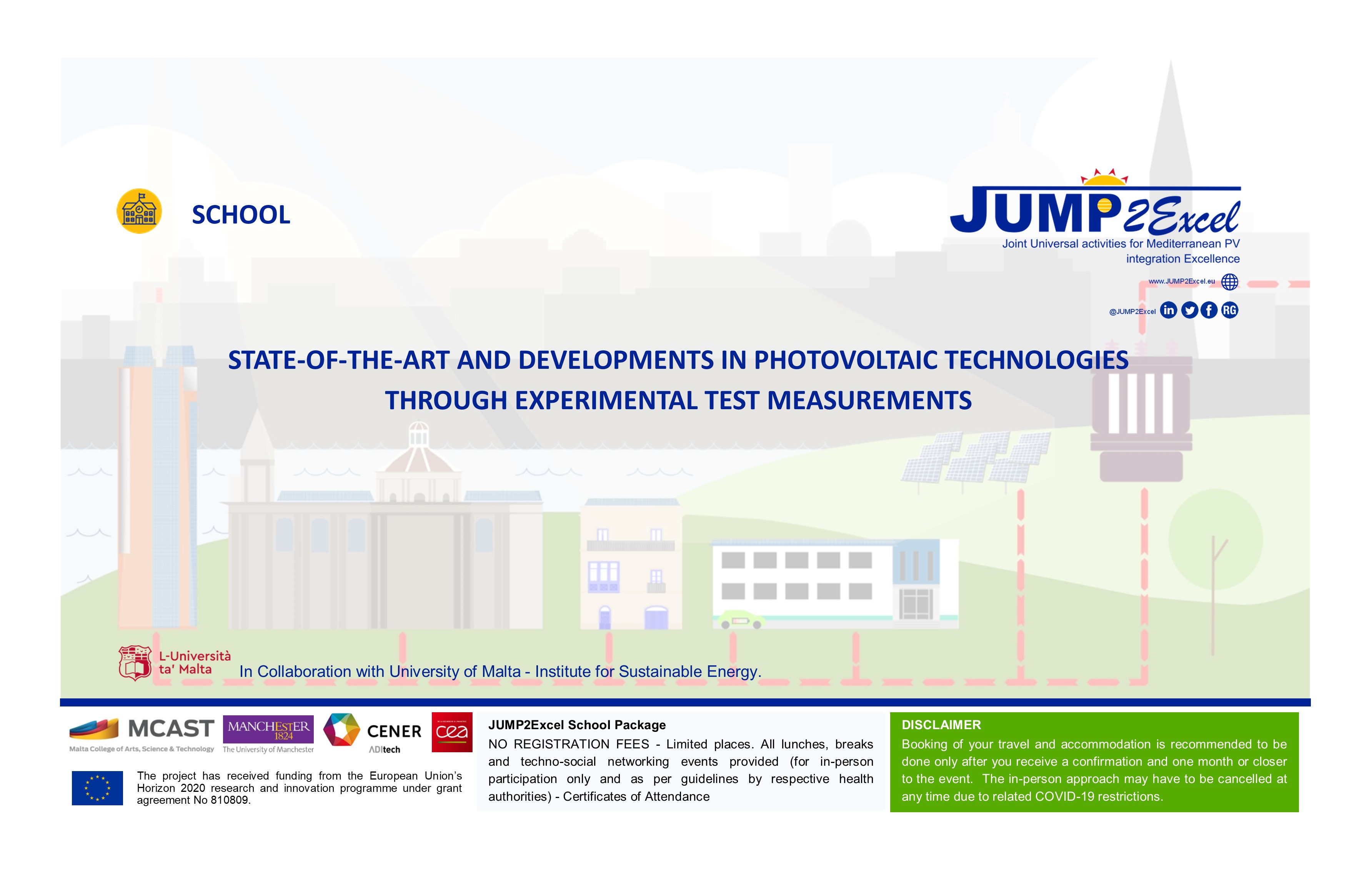
This school focuses on state-of-the-art and developments in photovoltaic technologies through experimental test measurements. This school provides the participants with the opportunity to understand and master excellently the current, new and upscaling PV technologies. This school also explores state-of-the-art of PV materials. The participants will be exposed to apply these methods and evaluate solutions to problems by adopting scholarly approaches.
Based on a needs analysis carried out by the International Council for Coaching Excellence (ICCE, 2016) and the academic literature on sports coaching (Lyle, 2002; Cushion & Lyle, 2017), the design of effective programmes for the future should see field experts from National Governing Bodies (NGBs), sports associations and clubs, join forces with sports coaching academics. Furthermore, experts have suggested that, in the constructivist vein, learners themselves are the key to developing relevant educational programmes, curricula and syllabi.
A joint partnership of four Higher Education Institutions (HEIs) will therefore be partnering with NGBs and prospective learners to design, develop and obtain accreditation for four level 6 units on Sports Coaching. The project brings together the University of Southern Denmark, Reykjavik University, Mugla Sitki Kocman University, and the Malta College of Arts, Science and Technology as lead partner. We will also be involving the International Council for Coaching Excellence (ICCE) in the quality assurance of the units developed in line with the ICCE's Standards for Higher Education Bachelor Coaching Degree Programmes.
Our project objectives:
-Addressing current gaps in sports coaching education through the development of four units which can be integrated in a level 6 course
-Promoting the results of our project beyond our project partnership
Our target groups:
-Sports coaching students and practitioners in the field-Sports coaching lecturers
-Higher education institutions (HEIs) providing sports coaching education
-Stakeholders in the field of sports coaching (e.g. NGBs and the ICCE)
The delivery of the units is to be piloted during the project in four weekend schools, organised in the Higher Education Institutions of each respective country. During its pilot phase, the project will also include mobility opportunities for six learners from each country to attend a weekend school in a foreign country and shadow an experienced coach in the workplace (job shadowing) for approximately 10 days. 1 foreign expert from the participating members will be invited in every weekend school to share his/her expertise with the academics and learners participating in the weekend school in its respective country.
In the long-term, the project will contribute to developing new and more innovative methodologies for developing units at higher education level. It will also establish closer cooperation among the participating HEIs as well as with the ICCE in the field of sport coaching education specifically. The developed units will continue to be integrated in sport coaching courses at level 6 in the participating HEIs. Through the envisaged project dissemination plan we will also be able to promote the project impact beyond our project partnership. The description of the units will remain available even after the end of the project.
OFFICIAL ENDORSEMENT and SUPPORT
Together with the collaborative support of the Malta Olympic Committee, Danish Sports Confederation, National Olympic & Sports Association of Iceland and Sports for all Federation Sports for All & Wellness Association, this project is officially endorsed by the Parliamentary Secretariat for Youth, Sport & Voluntary Organisations, headed by Parliamentary Secretary Hon Minister Dr Clifton Grima. The Parliamentary Secretariat will be invited for international meetings with representatives from foreign Universities, the ICCE and the foreign NGBs. Furthermore the generation of knowledge and intellectual output, together with good practices will be shared with the Secretariat as well.In 2015, IRENA identifies four applications in which batteries are deployed to increase the share of variable renewable energy and improve electricity supply reliability. These application areas are (i) island systems and off-grid/rural electrification with renewable energy deployment, (ii) households with solar photovoltaic (PV), (iii) variable renewable energy smoothing and energy supply shift and (iv) fast, short-term electricity balancing in ancillary markets. According to IRENA, the storage capacity of battery electricity storage (BES) systems in stationary applications by 2030 has to increase by a factor of at least 17 compared to today’s estimated level, to meet the requirements for doubling renewables in the global energy mix. This boom in storage will be driven by the rapid growth of utility-scale and behind-the-meter applications. Besides, it claims that the largest market for BES in the period to 2030 maybe the pairing of BES systems with the installation of new small-scale solar PV systems.
Besides that, The European Commission, through its Renewable Energy Directive, supports energy storage as a means to integrate renewables, in relation to the right of consumers to produce and self-consume electricity.
Additionally, the European Commission declares: “Energy storage is a key component in providing flexibility and supporting renewable energy integration in the energy system. It can balance centralized and distributed electricity generation, while also contributing to energy security. The development of storage technologies is an important component of the Strategic Energy Technology Plan and is also identified as a key priority in the Communication on Accelerating Clean Energy Innovation.”
In addition, during the last years, photovoltaic solar energy has experienced a great advance driven, to a great extent, by the development and application of the regulations which standardizes its use. Manufacturers of photovoltaic components certify their products according to international regulations to ensure that they meet the quality requirements demanded by the market. The Technical Committee 82 of the International Electrotechnical Commission (IEC) is one of the most relevant bodies in charge of preparing the standards of the photovoltaic sector. These standards include the requirements and qualification procedures that photovoltaic modules must comply with to ensure their correct performance during prolonged periods of time in moderate climatic conditions.
This School focuses on PV integration technical solutions: This school provides the participants with the opportunity to understand and master excellently the main concepts relating to the identified topic. This school also explores state-of-the-art theories and frameworks. The participants will be exposed to apply these methods and evaluate solutions to problems by adopting scholarly approaches.